
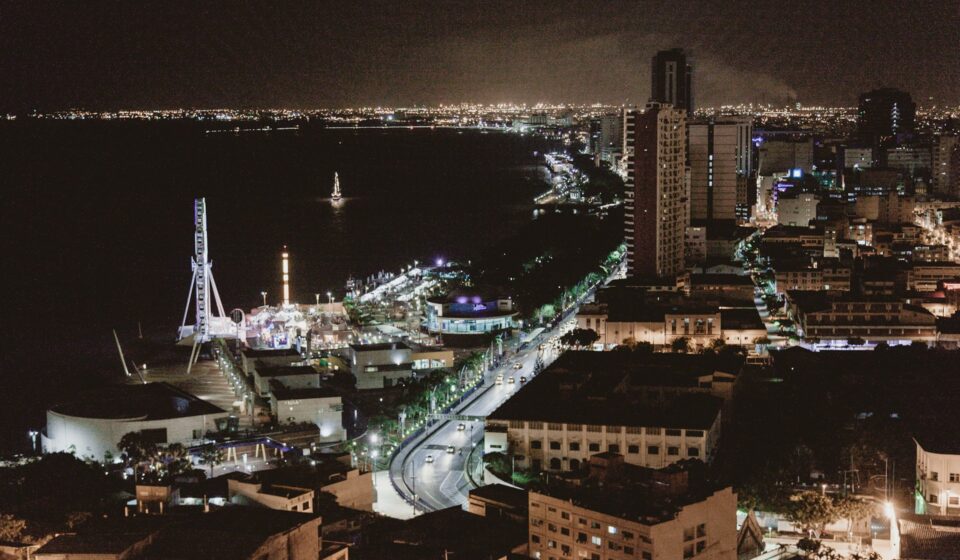

Featured image: aerial view of Guayaquil. Photo: Jose Garcia / Unsplash (Unsplash License). Illustrative.
GUAYAQUIL — A night-time curfew took effect at 00:00 on Sunday, November 1, in five coastal provinces of Ecuador: Guayas, Manabí, Los Ríos, El Oro and Esmeraldas. The restriction on the movement of people and vehicles in public spaces applies every night from midnight to 05:00 and lasts until the early hours of Tuesday, November 10. It covers Guayaquil and Milagro, both in Guayas province.
Within the first hour, the National Police had set up several checkpoints in Guayaquil, including one in the Portete area staffed together with agents of the city’s transit authority (ATM), while soldiers stopped vehicles on Francisco de Orellana Avenue near Pascuales, El Universo reported. Officers noticed that some drivers were confused about the start date and hours.
What the decree says
The measure was ordered by President Daniel Noboa in Executive Decree 519, signed on October 15, as part of the government’s campaign against organised crime. The decree says checks on people must be carried out “in a rational and proportionate manner” and that the Armed Forces, the National Police and transit agents must coordinate.
- Hours: 00:00 to 05:00, every night from November 1 to the early hours of November 10.
- Who can move: people facing medical care needs, emergencies or situations that put life or safety at risk.
- Services that continue: justice, public and emergency services and strategic sectors. The decree also allows the work of the media, the Ombudsman’s Office and accredited international organisations.
- Air travellers: during the previous curfew, passengers could travel with a printed or digital boarding pass, and airport staff with their work credential.
The curfew overlaps with the long holiday weekend for All Souls’ Day (November 2) and Cuenca’s independence day (November 3), so anyone travelling back to the coast should plan to arrive before midnight. Interior Minister John Reimberg told TC Televisión on October 30 that the police and the military are clear about the operations they will carry out, separately and jointly depending on the area.
The previous curfew
A similar curfew applied from September 17 to 30 in Guayas, Los Ríos, Manabí and El Oro. According to official figures cited by El Universo, it produced 2,561 arrests, 1,310 operations and 1,050 checkpoints, with 8.1 tonnes of drugs, 456 firearms, 12,800 rounds of ammunition and 40 explosives seized. Noboa has said crime fell by 40% during that period; that figure is the president’s and has not been independently verified.
The five provinces are also under a 60-day state of exception declared on September 17, which suspends the inviolability of homes and correspondence and also covers Pichincha, Santa Elena and Santo Domingo de los Tsáchilas. Santa Elena is not included in the new curfew.
Confirmed and pending
- Confirmed: provinces, hours, dates and decree number; checkpoints active in Guayaquil since the first night.
- Pending: the first official results of this curfew. The news reports we reviewed did not state the penalties for breaking it.
Related: Ecuador’s long weekend: heavy-rain warning for Guayas, VAT on tourism cut to 8%.
Sources
- El Universo — Curfew begins in five provinces; checkpoints in Guayaquil (Nov 1, 2026)
- Teleamazonas — Curfew in five provinces: hours and exceptions (Oct 15, 2026)
- Primicias — The five provinces under the November curfew (Oct 15, 2026)
- Lexis — Executive Decree 519
Celina Santa Cruz · Ecuador · Virtual editorial byline
English adaptation: Lin Wei · Editorial direction: Leonidas Ferraz · November 1, 2026 · AI-assisted writing


