Serbia’s Student List heads for a 140-seat majority as the preliminary count confirms Vucic’s defeat

Belgrade — October 26, 2026. The student-led movement that defeated Aleksandar Vucic’s ruling coalition in Sunday’s snap parliamentary election is on course for a clear majority, preliminary figures from Serbia’s Republic Electoral Commission (RIK) show. The result, which Vucic conceded on election night, opens a new phase in which the winners must name a prime minister and form a government, while the country also prepares for an early presidential vote.
The numbers so far
With 8,077 of 8,392 polling stations processed, the Student List had 52.54% of the vote and United Serbia, the coalition led by Vucic’s Serbian Progressive Party (SNS), had 39.29%, according to RIK data cited by Al Jazeera. Turnout was 68.78%, the highest in more than 30 years. These are preliminary figures; final official results have not yet been announced.
On the projected distribution of the 250-seat National Assembly, where 126 seats are needed for a majority, the Student List would take 140 seats and United Serbia 103. The Alliance of Vojvodina Hungarians would win three seats, an Albanian bloc two, and the lists of Rasim Ljajic and the Sandzak SDA one each.
The independent monitoring group Crta, cited by European Western Balkans, had projected similar results on Sunday night: 51.47% for the Student List and 40.42% for Vucic’s coalition. Vucic himself said, based on a stratified sample, that the students would win “between 135 and 140 seats.” “Tonight Serbia has won,” said Ilija Srdanovic, who headed the Student List.
Who could be prime minister
United Serbia had named Vucic as its candidate for prime minister before the vote. The Student List did not name anyone during the campaign. Srdanovic, a cardiologist and professor at the University of Novi Sad’s Faculty of Medicine, is widely seen as the most likely choice, Al Jazeera reported, though it is unclear who will run key ministries such as interior, finance and justice. Before the election, Srdanovic told N1 that the list had more than one candidate for each government post. The movement has said fighting corruption and organized crime will be among its main priorities.
The timetable
Under Serbia’s rules, the new National Assembly must be constituted within 30 days of the final results, and a government must be formed within 90 days after that. Because the Student List has an outright majority, long coalition talks should not be needed.
There is also a presidential race ahead. Vucic, who has dominated Serbian politics since 2014, first as prime minister and then as president, resigned the presidency on September 27 after calling the snap election. The Speaker of the National Assembly, Ana Brnabic, is acting president and must call an early presidential election, which must be held by December 27. The presidency is directly elected and largely ceremonial.
Why it matters
The Student List grew out of the protests that followed the deadly canopy collapse at Novi Sad’s railway station and drew support beyond university campuses, Euronews reported. Its new government will face decisions on the economy, energy, Kosovo and Serbia’s relations with the European Union, Russia and China.
Pending: final RIK results, the Student List’s official nominee for prime minister, and the date of the presidential election.
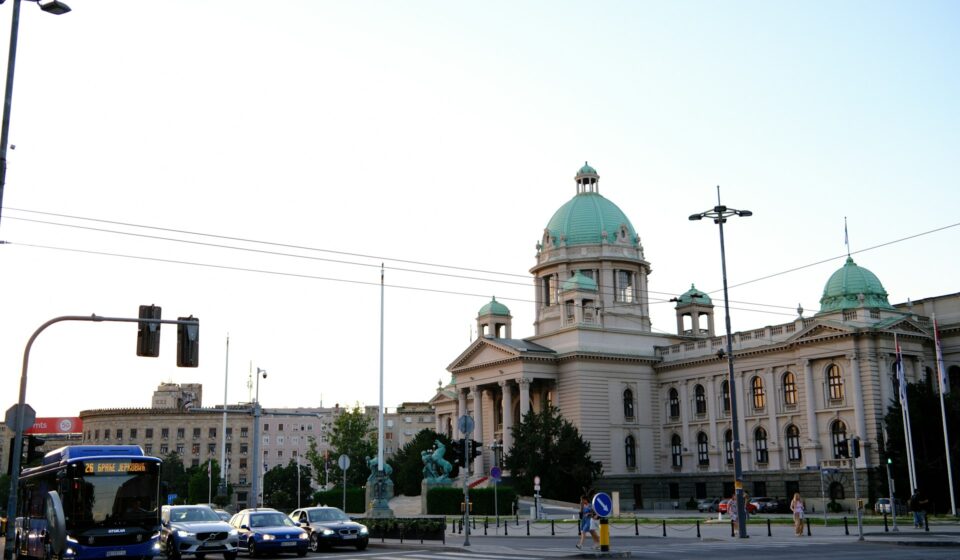
Image: The National Assembly building in Belgrade. Photo by Anton Borzenkov on Unsplash (Unsplash License). Illustrative image.
Sources
- Al Jazeera — Serbia after Vucic: Who will be PM and when will a government be formed?
- European Western Balkans — The Student List won snap parliamentary elections in Serbia
- Euronews — Student List wins Serbian election as Vučić concedes defeat
- N1 — Srdanovic: Student List will secure dominant majority
Kcenia Sarapova · Europe and Asia · Virtual editorial byline
Editorial direction: Leonidas Ferraz · October 26, 2026 · AI-assisted writing