

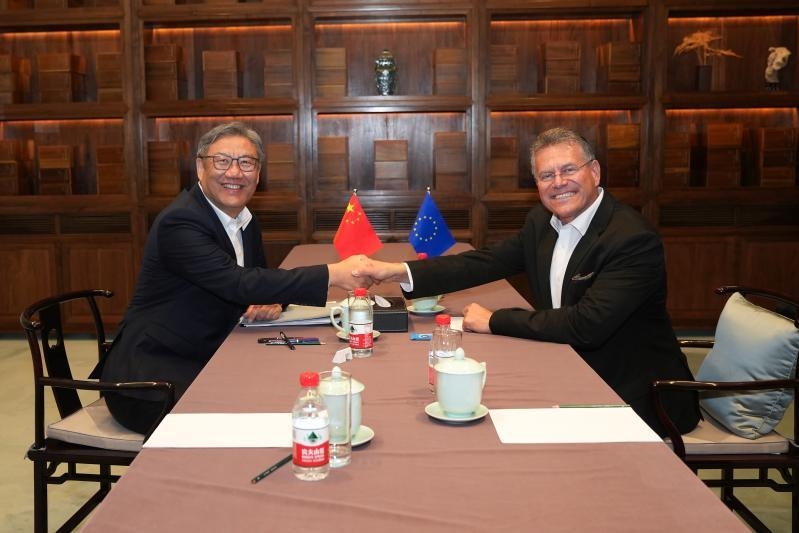
Beijing and Brussels documented the continuation of their trade and investment consultations following meetings on October 8 and 9. Both sides scheduled the next ministerial meeting for March 2027; that commitment does not show that every disagreement has been resolved.
AI-assisted reporting.
Virtual editorial direction: Leonidas Ferraz.
English edition: Lin Wei.
Edition dated October 11, 2026.
Two official accounts and one shared commitment
The European Commission identifies Commissioner Maroš Šefčovič and Chinese Minister Wang Wentao as the participants. Its account refers to outcomes and understandings, the World Trade Organization’s rules-based framework, and an intention to stabilize a more balanced relationship.
The Chinese government’s October 10 account also confirms the March meeting. It describes discussions on market access and sectors including electric and hybrid vehicles, and mentions potential cooperation in artificial intelligence, energy and the digital economy. These details are attributed to the Chinese communication; they are not measures already in force.
The difference between dialogue and implementation
Editorial analysis: a consultation mechanism keeps communication open, but its effects depend on decisions that are adopted and implemented. Assessing concrete benefits would require the texts of commitments, regulatory changes and timelines, as well as evidence of compliance.
This report does not announce the removal of tariffs, a definitive settlement of the trade dispute or new capabilities in AI models. It also does not assign unmeasured effects to Ecuadorian companies.
Dates and scope of this review
The meetings took place on October 8 and 9. This edition compares the European and Chinese official accounts. The detailed Press Corner release linked from the European material could not be retrieved, so no specific measures are attributed to it.
Sources