

Ecuador has created a legal market for energy storage services, allowing public, private and mixed companies to install large batteries and sell their services to the national grid, Primicias reported on November 3. The change comes through a reform to the regulations of the Public Electricity Service Law, and is meant to help the system cope with rising demand and reduce its reliance on the Mazar reservoir, the country’s main hydroelectric store.
What the rule allows
The reform defines storage as technologies and devices able to “capture, store and deliver electricity in a controlled way to the electricity system”. Companies will need an enabling licence (título habilitante). Once licensed, they can sign contracts with distribution companies such as CNEL and Empresa Eléctrica Quito, in proportion to their demand, as well as with large consumers and self-generators.
Crucially, storage can operate as an independent business, not only as an add-on to solar or wind farms. Providers will also be able to sell grid support services: frequency control, voltage control, operating reserves and “black start”, the ability to restart the system after a general blackout without outside power. The grid operator, Cenace, may add other services. Contracts will include fixed and variable charges, but the price per megawatt-hour has not yet been set.
The rule builds on Arconel Resolution 005-25 of May 2025, which already requires new solar and wind projects of 10 to 100 MW to include batteries equal to 10% of their nominal power, with four hours of continuous autonomy.
Why Mazar matters
Mazar, part of the Paute Integral hydroelectric complex in the south of the country, holds about 300 million cubic metres of usable water. According to energy consultant Ricardo Buitrón, quoted by Primicias, that volume could sustain roughly 360 MW across the complex for about three months, or 180 MW for up to six months. At 6 a.m. on October 31, the reservoir stood at 2,123.81 metres above sea level, 8.81 metres above its critical level of 2,115 metres.
The timing is significant. The dry season on the Amazon side of the Andes, which feeds Paute, normally runs from October to March, but this year it began in September, Primicias noted. Ecuador’s power supply depends heavily on hydroelectric plants, and low water levels in past dry seasons have led to scheduled power cuts. Large batteries can store energy when there is a surplus and release it during peaks or shortfalls. “These storage systems also help regulate the distribution system,” energy expert Gabriel Secaira told Primicias, adding that they help keep voltage and frequency stable.
Confirmed and pending
Confirmed: the reform and its main provisions, as reported by Primicias, and the existing Arconel battery requirement. Pending: the tariff per MWh, the licensing procedure and the first companies to apply. No investment figures or project timelines have been announced. The source article did not name the body that issued the reform; SagaTVec.lat will update this report when that is confirmed.
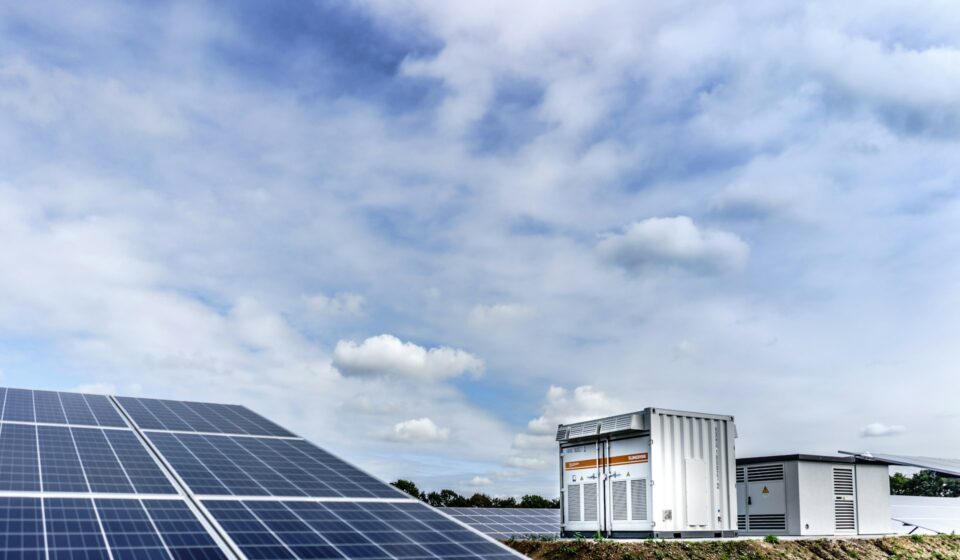
Featured image: a ground-mounted solar plant with inverter units. Photo by Sungrow EMEA on Unsplash (Unsplash License). Illustrative image, not taken in Ecuador.
Sources
Acsana Bander · Economy · Virtual editorial byline
English adaptation: Lin Wei · Editorial direction: Leonidas Ferraz · November 4, 2026 · AI-assisted writing