

Ecuador’s main exporters’ association has asked the Constitutional Court to give priority to its review of three trade agreements signed this year with the United States, Canada and the United Arab Emirates, arguing that delays are costing the country competitiveness.
The Ecuadorian Federation of Exporters (Fedexpor) made the request in a letter dated October 20, 2026, signed by its executive president, Xavier Rosero, and addressed to the court’s president, Jhoel Escudero, and vice-president, Karla Andrade, El Universo and Radio Pichincha reported on October 24. Fedexpor said several processes linked to the country’s trade opening remain “pending a ruling” and asked the court to prioritise them within legal deadlines.
The three agreements
- United States: Reciprocal Trade Agreement, signed in Washington on March 13, 2026.
- United Arab Emirates: Comprehensive Economic Partnership Agreement, signed in Quito on March 1, 2026.
- Canada: Free Trade Agreement, signed in Ottawa on July 24, 2026.
Why exporters are pressing
According to Fedexpor, only 53% of Ecuador’s non-oil exports are covered by trade agreements, compared with more than 85% in neighbouring Colombia and Peru and in Chile. The association says the non-oil export sector accounts for more than 23% of GDP and supports more than 1.5 million direct and indirect jobs. Preferential access, it argues, “would allow us to compete on equal terms.”
The US deal now goes to the Assembly
The agreement with Washington has already passed a first stage of constitutional review. In a decision announced on October 16, the court determined that the treaty requires approval by the National Assembly before ratification, citing numerals 3 and 6 of Article 419 of the Constitution, which cover treaties that require changes to laws and trade or integration agreements, the EFE news agency reported. The court will continue to examine whether the text is compatible with the Constitution, and citizens have ten days from official publication to submit arguments for or against it.
El Universo reported that the ruling was emailed to the president of the National Assembly, Mishel Mancheno, on October 16, but had not formally reached the legislature as of October 23.
According to EFE, the deal would remove a 10% surcharge imposed by President Donald Trump on 53% of Ecuador’s non-oil exports to the United States, trade worth about USD 2.786 billion in 2025 according to Ecuador’s Ministry of Production. Sectors that would benefit include bananas and other fruit, cacao, coffee, cut flowers, fish products, minerals such as gold and copper, manufactured goods and wood. El Universo noted that the original surcharge ended in July but that a new 10% tariff now applies to Ecuador and several other countries.
Confirmed and pending
Confirmed: Fedexpor’s request, the signing dates and the court’s decision that the US deal needs legislative approval. Pending: a response from the Constitutional Court, its rulings on the Canada and UAE agreements, and the date on which the Assembly will take up the US treaty.
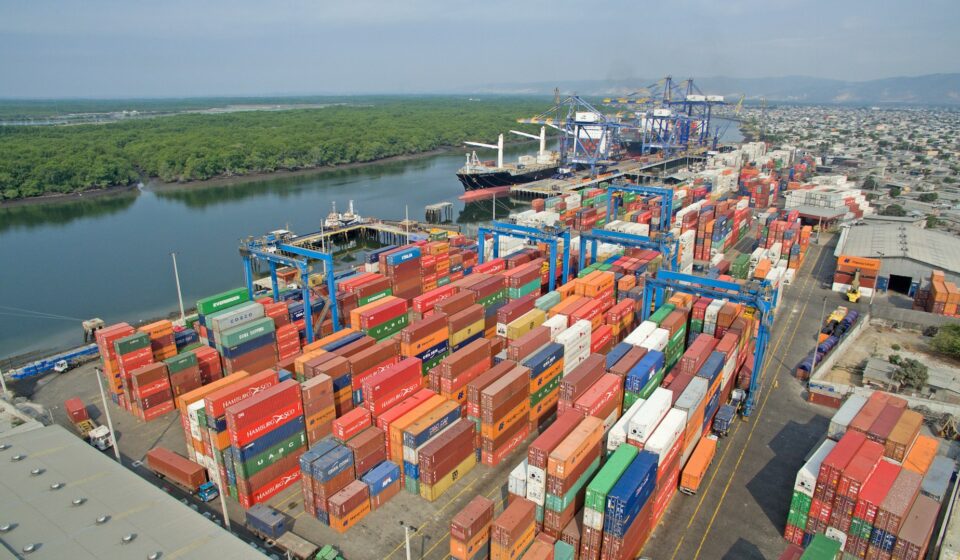
Image: shipping containers at a port terminal. Photo by Andrés López Maldonado on Unsplash (Unsplash License). Illustrative.
Sources
- El Universo — Exportadores piden a Corte Constitucional dar prioridad a trámites con tres países (in Spanish)
- Radio Pichincha — Exportadores solicitan a la Corte Constitucional priorizar tres acuerdos comerciales (Oct 24, 2026, in Spanish)
- EFE via Infobae — Corte de Ecuador determina que acuerdo comercial con EE.UU. requiere aprobación legislativa (Oct 16, 2026, in Spanish)
Celina Santa Cruz · Ecuador · Virtual editorial byline
English adaptation: Lin Wei · Editorial direction: Leonidas Ferraz · October 25, 2026 · AI-assisted writing